Abstract
We propose RAP, a fast rendering-free importance prediction method for 3D Gaussian Splatting. RAP leverages intrinsic Gaussian attributes and local neighborhood statistics to directly predict primitive importance using a lightweight MLP, without requiring multi-view rendering analysis. The method generalizes well and can serve as a plug-and-play module for pruning, compression, and transmission tasks, significantly improving efficiency and storage compactness while preserving reconstruction quality.
RAP Training and Inference Framework
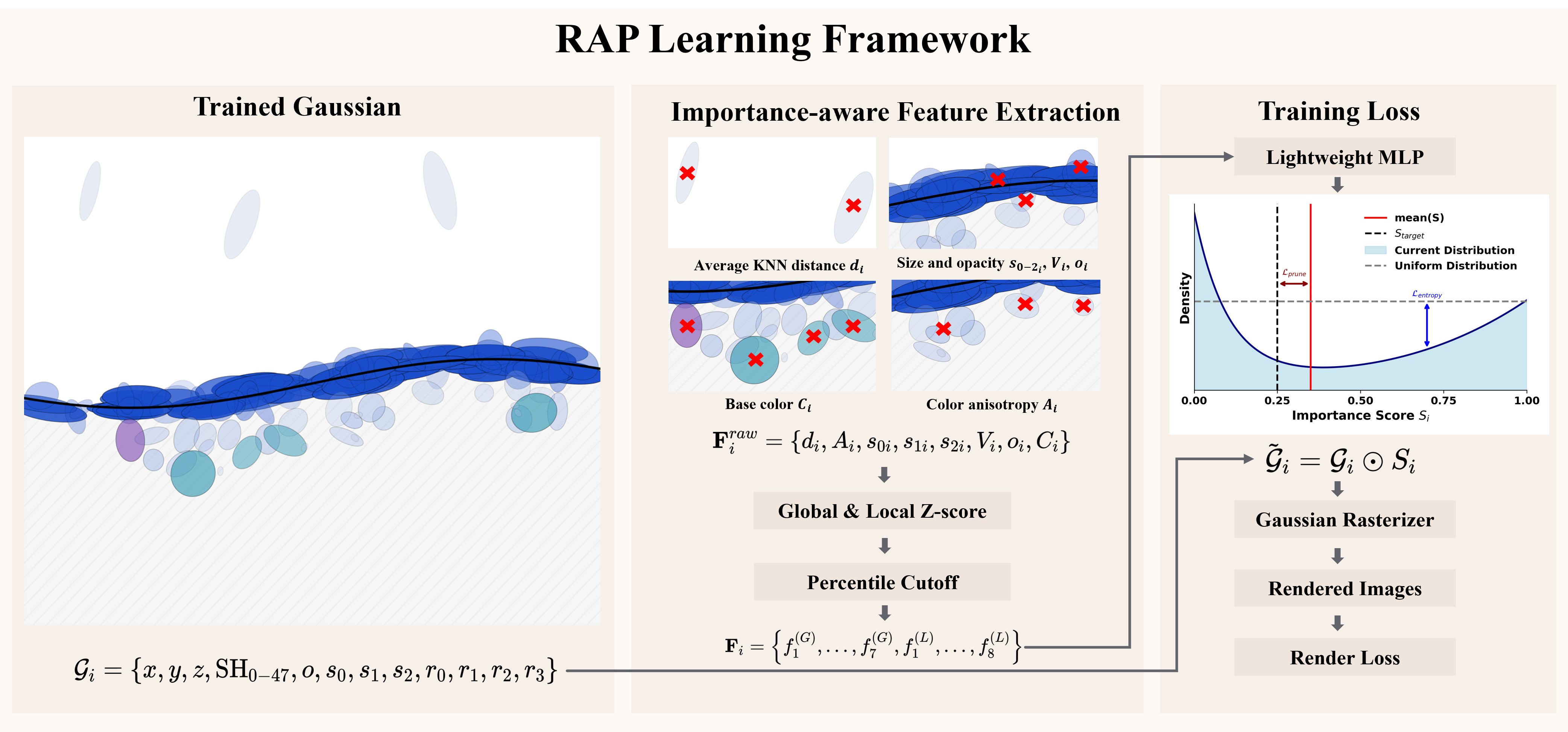
The figure below shows the training framework of RAP. During training, RAP learns importance prediction from intrinsic Gaussian attributes and local neighborhood statistics. During evaluation, we directly extract features and feed them into the trained MLP to obtain importance scores, without rendering-based analysis.
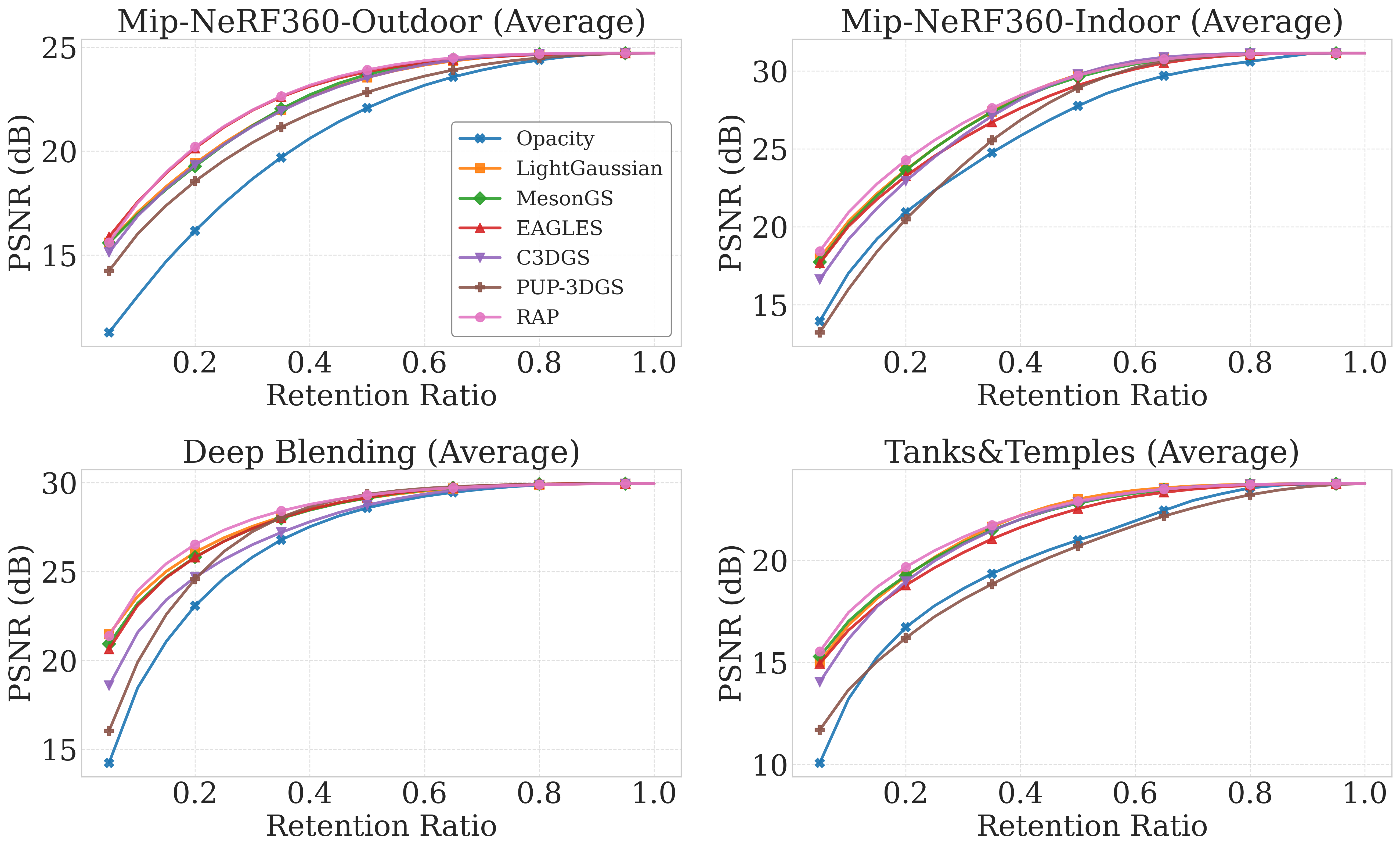
Direct Pruning without Optimization
RD curves on Mip-NeRF360, Deep Blending, and Tanks&Temples. This result corresponds to direct pruning without post-optimization.
Reconstruction with Pruning
Results of reconstruction with pruning 40% primitives every 1500 iterations.

5% Primitive Retention Visualization
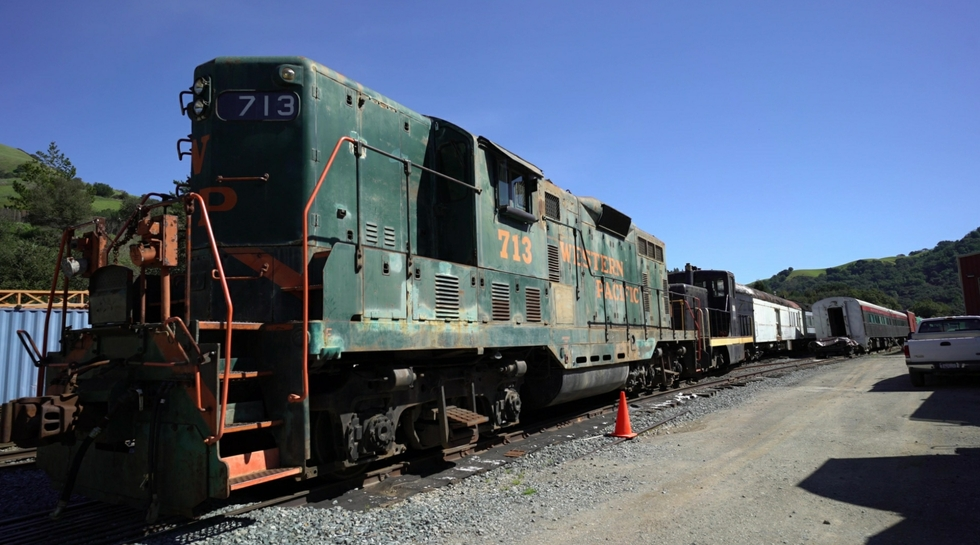
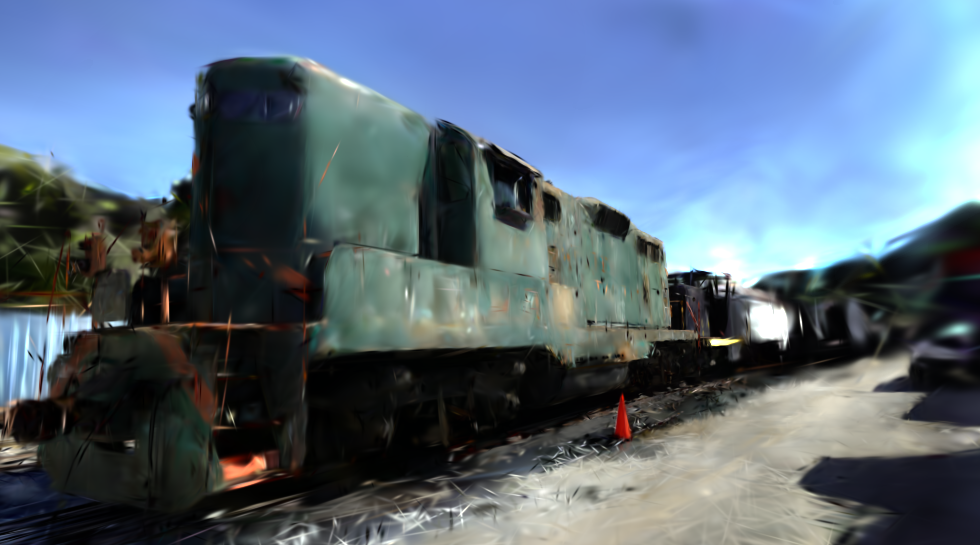
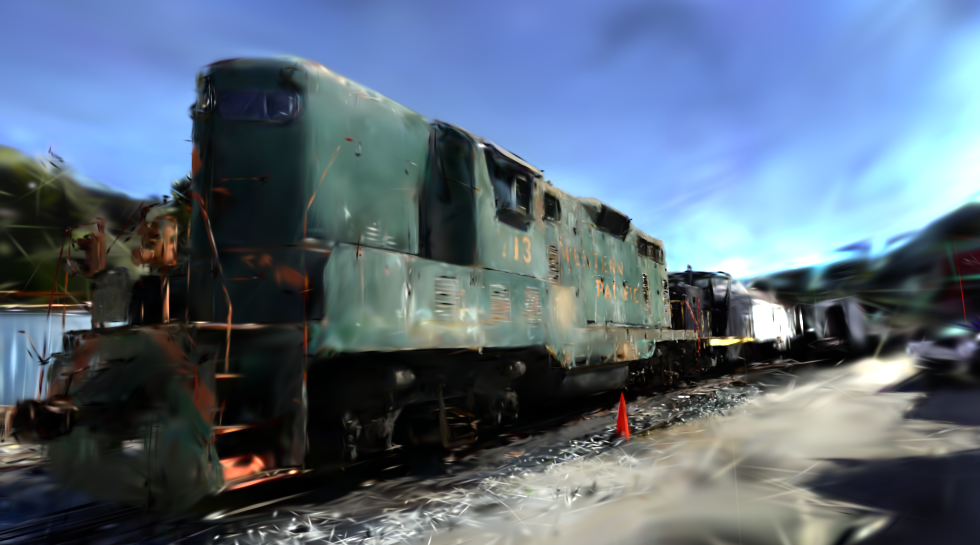
Only 5% primitives are retained. LightGS (visibility-based) tends to preserve central regions that are visible from most views, often causing strong background distortion. PUP (gradient-based) tends to preserve boundaries. RAP provides a more uniform downsampling over the whole scene. Different importance prediction strategies can be selected based on application needs.
GT
LightGS
PUP

RAP
BibTeX
@article{yang2026rap,
  title={RAP: Fast Feedforward Rendering-Free Attribute-Guided Primitive Importance Score Prediction for Efficient 3D Gaussian Splatting Processing},
  author={Kaifa Yang and Qi Yang and Yiling Xu and Zhu Li},
  journal={CVPR},
  year={2026},
  url={https://sekiroyyy.github.io/rap_webpage/}
}